
Heart Line Meaning in Palm Reading: What Palmists Say
Sources include:
 Internet Archive
 NCBI Bookshelf
 Nicklaus Children's Hospital
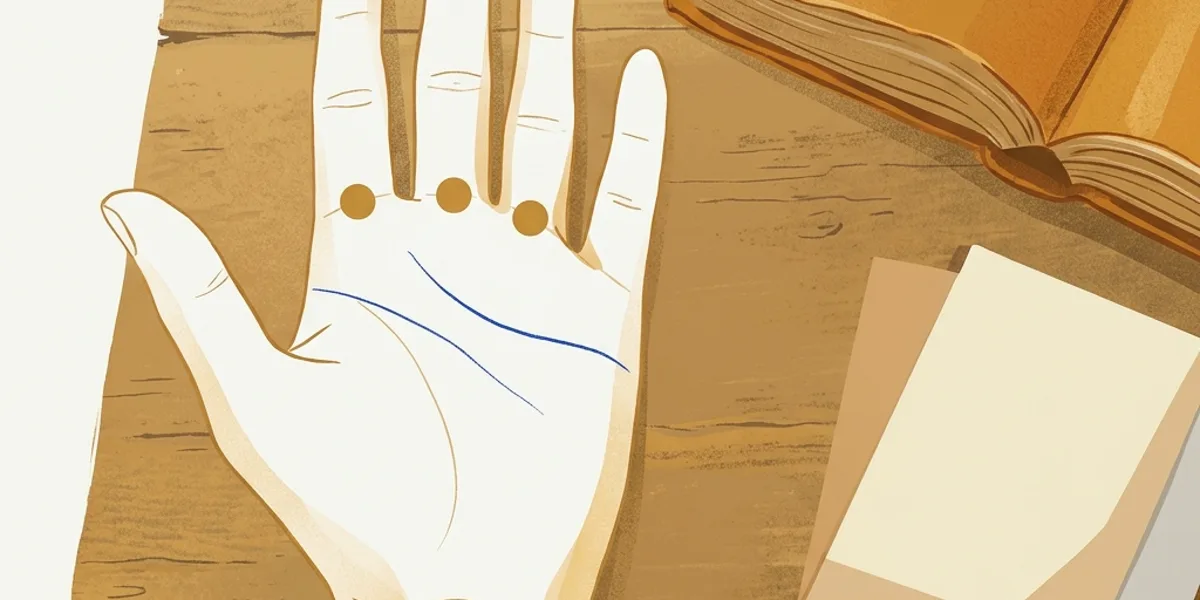
Quick answer
The heart line is the top long crease across your palm, running from below the little finger toward the index or middle finger. Palmists read its length, end point, curve, depth, breaks and forks as signs of how you love. That's a tradition, not a proven prediction; in anatomy it's the distal palmar crease, which forms before birth.
The heart line is the highest of the long creases across your palm, just below the base of your fingers. Palmists read it as the line of feeling: affection, emotional style and relationships. Cheiro, the best-known Western palmist around 1900, wrote that it “relates purely to the affectionate disposition.”
In anatomy, the top crease of the palm is called the distal palmar crease: “distal” means farther from the wrist. It's a flexion crease, a fold in the skin where the hand bends.
This guide explains what palmists say the heart line means. We present palmistry as a cultural tradition and as entertainment, not as a way to predict events or measure personality.
Heart line: the top crease, read for feeling
Head line: read for thinking style
Life line: around the thumb
- A under the index finger
- B between the index and middle fingers
- C under the middle finger
- D curving down to the head line
How to find the heart line on your own hand
Most people have three creases in their palms. Palmists call them the heart line, the head line and the life line.
- Use good light. Hold your hand palm up, fingers together and relaxed.
- Find the base of your fingers. The heart line is the first long crease below them.
- Start at the outer edge. Look below your little finger, on the side of the palm. One end of the heart line is here.
- Follow it across. Trace it toward your index finger and note where it ends: under the index finger, between the index and middle fingers, under the middle finger, or curving down toward the line below.
- Find the line under it. The next long crease down is the head line. The curved line around the base of your thumb is the life line.
- Bend your fingers a little. Creases deepen when the hand flexes, so faint parts are easier to see.
- Check both hands. Palmists compare them (see below).
A note on direction. Most modern guides say the line “starts” under the little finger. Cheiro read it the other way, describing where the line “rises” at the index-finger end. Both describe the same end. If an older book says the heart line “rises on the Mount of Saturn,” it means the end under your middle finger.
What palmists say each feature means
The table sets common modern readings beside Cheiro's own words, all from his chapter “The Line of Heart and its Variations” in Palmistry for All. A dash means we're not quoting him for that feature. Modern readings vary from reader to reader, so treat them as conventions, not rules.
| Feature | Common modern reading | What Cheiro wrote |
|---|---|---|
| Ends between the index and middle fingers | Balance of feeling and good sense | “a calmer but a very deep nature” |
| Ends under the middle finger (mount of Saturn) | Practical in love | “rather selfish in all questions of affection” |
| Ends under the index finger (mount of Jupiter) | Idealistic about love, high standards | — |
| Forked: one branch under the index finger, one between index and middle | Balance of emotion and practical sense | “an excellent sign of a well-balanced, happy, affectionate disposition” |
| Short line | A more reserved style of affection | “The shorter the Line of Heart … the less the higher sentiments of the affection make themselves manifest” |
| Extremely long line | Open, expressive affection | “a terrible tendency toward jealousy” |
| Deep and clear | Steady, strong feeling | The line “should be deep, clear, and well coloured” |
| No heart line at all | — | “a cold-blooded, unemotional nature” |
| Curves down toward the head line | Feelings and thinking closely tied | — |
| Straight line | Private, thoughtful in love | — |
Compare the long-line rows: many modern guides treat a long heart line as a good sign, while Cheiro warned that an extremely long one leaned toward jealousy. Readers have never agreed on one meaning for each feature.
Curve. An upward-curving line is read as warm and open; a straight line as more private.
Breaks. A gap is usually read as an emotional turning point or a hard period. Many readers say overlapping broken ends mean recovery.
Branches and marks. Small branches rising toward the fingers are read as hopeful feelings, branches dropping down as disappointments, and chains or small islands as periods of strain.
Reading it with the head line and life line
Palmists rarely read one line alone. The head line is read for thinking style, and the life line for energy and major life changes. Most readers say the life line doesn't show how long you'll live.
- The space between heart and head lines. A wide gap is read as an open, easygoing nature; a narrow one as more guarded.
- Where they meet. A heart line that dips to touch the head line is read as feeling and reasoning working as one.
- Which is stronger. A deeper heart line is read as feelings leading; a deeper head line as reason leading.
The single crease. Sometimes the heart and head lines run as one line across the palm. It's most often called a single palmar crease; the older term “simian crease” is rarely used now because it tends to have a negative meaning, according to FloridaHealthFinder. Nicklaus Children's Hospital says it occurs in about 1 in every 30 people and “in most cases, it is completely normal.” Palmists often read it as intense focus. At about 1 in 30 people, it isn't rare.
If you have a question about a crease on a baby's or child's hand, ask a pediatrician. A palm reader can't assess health.
Left hand or right hand
The most common convention:
- Non-dominant hand: what you were born with, your natural tendencies.
- Dominant hand: how you've developed and the life you've lived.
Some readers use only the dominant hand; others always read both and treat differences as change over time. It's common for your two heart lines to look different, so ask your reader which method they use.
Western, Indian and Chinese traditions
All three link the heart line to emotion. They differ in names and in the wider system they read the hand within.
Western. Modern Western palmistry owes much to Cheiro. His Language of the Hand promised “fifty-five full-page illustrations, and over two hundred engravings of lines, mounts, and marks,” and its chapter “The Line of Heart” starts on page 98. Western readers name the pads of the palm after planets: the mount of Jupiter under the index finger, the mount of Saturn under the middle finger.
Indian. In India, palm reading is part of Samudrika Shastra, a wider tradition of reading the body, and is often practiced alongside astrology. The heart line is commonly called Hriday Rekha, “heart line” in Hindi.
Chinese. Chinese palmistry commonly calls it the emotion line (感情线, gǎnqíng xiàn).
When the heart line forms: the numbers
These figures come from a medical textbook chapter, not from palmistry. StatPearls (NCBI Bookshelf) describes fetal hand development “between 6 and 14 weeks of gestation” in three phases:
| Phase | Weeks of pregnancy |
|---|---|
| The hand's shape forms | 6 to 10 |
| The creases appear | 10 to 13 |
| Skin ridges form | 13 onward |
Our arithmetic: hand development spans 14 − 6 = 8 weeks, and the crease phase 13 − 10 = 3 weeks. So the crease palmists call the heart line is in place by about week 13 of pregnancy, months before birth.
And at about 1 in 30 people with a single crease, that's 1 ÷ 30 ≈ 3.3%, or about 10 people in a group of 300.
What the evidence says
We found no peer-reviewed research showing that palm lines predict personality, love life or future events. The scientific sources that describe the heart line are medical ones, and they treat it as a skin crease that forms before birth.
Palm reading can still be enjoyable and meaningful as a tradition, and a good prompt for thinking about how you handle feelings. Just keep it in that place. Don't use a reading to make relationship, health or money decisions: a licensed counselor can help with relationships, and a doctor with your hands or health.
Getting a reading in person
A reader can look at both hands in good light, see faint lines and compare the heart, head and life lines together. They can also tell you which tradition they follow. To find one near you, use our palm reader search. Before you book, ask about their tradition, the price and how long the session lasts, and see how to spot a psychic scam.
Looking for a reader near you? Compare prices and ask the right questions first.
Find palm readers near meFrequently asked questions
›What does a long heart line mean in palm reading?
Many modern palmists read a long heart line as open, expressive affection. Cheiro wrote that the shorter the line, the less the higher sentiments of affection show, but warned that an extremely long line denotes “a terrible tendency toward jealousy.” These are traditional readings, not proven traits.
›Where does the heart line start and end?
It runs across the top of the palm from the little-finger edge toward the index finger. It may end under the index finger, between the index and middle fingers, under the middle finger, or curve down toward the head line. Older books like Cheiro's describe where it “rises” at the index-finger end.
›What does a broken heart line mean?
In palmistry, a break is usually read as an emotional turning point or a hard period, and many readers say overlapping ends mean recovery. There's no evidence that a break predicts real events.
›Which hand should I read for the heart line?
A common convention reads the non-dominant hand for natural tendencies and the dominant hand for how you've developed. Some readers use only the dominant hand; many compare both.
›What if my heart line and head line are one line?
That's a single palmar crease. Nicklaus Children's Hospital says it occurs in about 1 in 30 people and in most cases is completely normal. Palmists often read it as intense focus. For questions about a child's hand, ask a pediatrician.
›Is palm reading scientifically proven?
No. We found no peer-reviewed research showing that palm lines predict personality or events. Medically, the heart line is the distal palmar crease, which appears between weeks 10 and 13 of pregnancy. Enjoy palm reading as a tradition and as entertainment.
Sources
- Palmistry for All, by Cheiro (Project Gutenberg plain text) (Project Gutenberg)
- Cheiro's Language of the Hand (full text) (Internet Archive)
- Embryology, Hand (StatPearls) (NCBI Bookshelf)
- Single palmar crease (FloridaHealthFinder)
- Simian Crease (STPC) (Nicklaus Children's Hospital)
Palmistry is presented here as a cultural tradition and entertainment, not as prediction or health advice.