
Palm Lines Meaning: A Chart of All 11 Lines
Sources include:
 NCBI Bookshelf
 Nicklaus Children's Hospital
Quick answer
Palmistry reads four major lines: the heart line for feeling, the head line for thinking, the life line for energy and change (not lifespan), and the fate line for career. Minor lines like the sun, Mercury and marriage lines add detail. These are traditional meanings for fun and reflection, not predictions.
Your palm has four major lines and up to seven minor ones. Palmists read the heart line for how you love, the head line for how you think, the life line for energy and big changes, and the fate line for career and direction. The minor lines add detail, and many people don't have all of them.
This chart covers all 11, with what palmists traditionally read in each, where the classic and modern sources disagree, and a free version you can print. We present palmistry as a cultural tradition and as entertainment. No line can tell you your future, your health or how long you'll live.
- Heart linemajorHow you love and show feeling
- Head linemajorHow you think and decide
- Life linemajorEnergy and big changes (not how long you'll live)
- Fate linemajorCareer and life direction
- Sun (Apollo) lineSuccess, recognition, creativity
- Mercury (health) lineHealth, in old books. We don't read it that way
- Marriage linesClose relationships
- Girdle of VenusSensitivity and moods
- Intuition lineIntuition and vivid dreams
- Mars lineDrive and resilience
- BraceletsTraditionally, health and fortune
What palm lines are
Palm lines are creases in the skin where the hand folds. They appear before birth: between about 10 and 13 weeks of pregnancy, according to StatPearls. Doctors call the main ones the distal palmar crease (the heart line), the proximal palmar crease (the head line) and the thenar crease (the life line).
Palmistry gives those creases meanings. The best-known Western system comes from Cheiro (William John Warner, 1866–1936), whose book Palmistry for All is in the public domain, so we quote it directly. Modern guides keep most of his names and change many of his meanings, as you'll see below.
The four major lines
| Line | Where to find it | What palmists read in it |
|---|---|---|
| Heart line | The top crease, from below the little finger toward the index finger | Feeling, affection, how you love |
| Head line | The next crease down, starting on the thumb side | Thinking style, judgment |
| Life line | Curving around the base of the thumb | Energy, resilience, changes in direction |
| Fate line | Up the middle of the palm toward the middle finger | Career, purpose, outside influences |
Heart line
Cheiro wrote that the heart line “relates purely to the affectionate disposition.” Palmists look at where it ends, how long and deep it is, and whether it curves or forks. A curving line is read as open and expressive, a straight one as more private. Our heart line guide covers every variation, with Cheiro's readings beside modern ones.
Head line
Cheiro called the head line “the most important line on the hand,” and compared it to “the needle in the compass.” A straight line is read as practical and logical; one that curves down toward the base of the palm as imaginative. Whether it starts joined to the life line or separate from it is one of the first things palmists check.
Life line
The life line, in Cheiro's words, “runs round the base of the thumb.” Palmists today read it for energy, resilience and big changes, such as a move or a new career, shown by breaks or branches.
Cheiro also believed it could “foretell the length of life.” Modern palmists reject that, and so do we: the life line doesn't show how long you'll live. A short life line is common and means nothing about lifespan.
Fate line
The fate line runs up the middle of the palm toward the middle finger. Cheiro wrote that it “appears to indicate at least the main events of one's career,” and that it can “look faint or shadowy.” Many people have a faint fate line or none at all, and that's normal.
Read the transcript
Every line on your palm has a name. Major line 1: Heart line. How you love and show feeling. Major line 2: Head line. How you think and decide. Major line 3: Life line. Energy and big changes (not how long you'll live). Major line 4: Fate line. Career and life direction. Minor line 5: Sun (Apollo) line. Success, recognition, creativity. Minor line 6: Mercury (health) line. Health, in old books. We don't read it that way. Minor line 7: Marriage lines. Close relationships. Minor line 8: Girdle of Venus. Sensitivity and moods. Minor line 9: Intuition line. Intuition and vivid dreams. Minor line 10: Mars line. Drive and resilience. Minor line 11: Bracelets. Traditionally, health and fortune. Myth: a short life line means a short life. It doesn't. Palm creases form before you're born. Palm Lines Chart: free to print and share at palmreadingnearme.com.
The seven minor lines
| Line | Where to find it | What palmists read in it |
|---|---|---|
| Sun (Apollo) line | Up toward the ring finger | Success, recognition, creativity |
| Mercury line | Slanting up toward the little finger | Old books read it for health; we don't |
| Marriage lines | Short marks on the edge of the palm, below the little finger | Close relationships |
| Girdle of Venus | An arc above the heart line | Sensitivity, moods |
| Intuition line | A half-circle on the little-finger edge of the palm | Intuition, vivid dreams |
| Mars line | Inside the life line, running beside it | Drive, resilience |
| Bracelets | Creases across the wrist | Traditionally, health, wealth and happiness |
Sun line. Cheiro called it “the Line of Success or the Line of Brilliancy,” and said the quality it shows is “what is generally called ‘luck’.” In his examples it ascends “to the base of the third finger,” the ring finger.
Mercury line. Cheiro called it the Line of Health and said it rises “at the base of or on the face of the Mount of Mercury,” under the little finger. He believed it could foretell illness. We don't repeat health readings: a palm can't show health, so for any question about your health, ask a doctor.
Marriage lines. Cheiro placed them “on the side of the Mount under the fourth finger,” and wrote: “Only the clearly formed lines relate to marriage, the short ones to deep affection.” Modern readers usually read them as close relationships of any kind. They don't count marriages or predict them.
Girdle of Venus. A “semi-circular line” that Cheiro described as running “from the base of the first finger to the base of the fourth,” often in pieces. It's read for sensitivity and changing moods.
Intuition line. Cheiro described a half-circle “from the face of the Mount of Mercury to that of the Mount of the Moon,” read for intuition and “clear vivid dreams.”
Mars line. A line “inside the Line of Life” that Cheiro said is “not found on all hands.” Palmists read it as extra drive and resilience backing up the life line.
Bracelets. The creases across the wrist. Cheiro wrote that the Greeks called them “the Bracelets of Health, Wealth, and Happiness,” and that they are “of very little importance.”
Where the sources disagree
We compared Cheiro with two of the guides that rank highest for this search today, Almanac.com and LoveToKnow, on six common questions. The palmistry sources contradict each other on four of them (lifespan, the heart line under the index finger, the sun line and a missing fate line). On the other two, they contradict the medical sources.
Does the life line show how long you'll live?
- Cheiro (1900s):
- Yes: it can “foretell the length of life from natural causes.”
- Almanac.com:
- No: “Length does not determine longevity.”
- LoveToKnow:
- No: “it doesn't.”
- What we checked:
- No. It's a skin crease that forms before birth.
A heart line that starts under the index finger
- Cheiro (1900s):
- “one of the best of the variations”
- Almanac.com:
- —
- LoveToKnow:
- May show someone “displeased with the pleasures of love”
- What we checked:
- Opposite readings of the same line.
Where the sun (Apollo) line runs
- Cheiro (1900s):
- Up to “the base of the third finger” (ring finger)
- Almanac.com:
- “close to the pinky”
- LoveToKnow:
- —
- What we checked:
- The Mount of the Sun sits under the ring finger, so we follow Cheiro.
No fate line at all
- Cheiro (1900s):
- “very colourless lives”
- Almanac.com:
- Your future is shaped “by hard work instead”
- LoveToKnow:
- —
- What we checked:
- Opposite readings. Many people have no clear fate line.
Do palm lines show heart health?
- Cheiro (1900s):
- An island on it means “weakness of the heart”
- Almanac.com:
- Linked to “the physical condition of your heart”
- LoveToKnow:
- About love only
- What we checked:
- No. A palm can't show health; ask a doctor.
Heart and head lines joined (single crease)
- Cheiro (1900s):
- —
- Almanac.com:
- Can lead to “impulsive behavior and, in some cases, aggression”
- LoveToKnow:
- —
- What we checked:
- About 1 in 30 people have one, and it's “completely normal” in most cases (Nicklaus Children's).
| Question | Cheiro (1900s) | Almanac.com | LoveToKnow | What we checked |
|---|---|---|---|---|
| Does the life line show how long you'll live? | Yes: it can “foretell the length of life from natural causes.” | No: “Length does not determine longevity.” | No: “it doesn't.” | No. It's a skin crease that forms before birth. |
| A heart line that starts under the index finger | “one of the best of the variations” | — | May show someone “displeased with the pleasures of love” | Opposite readings of the same line. |
| Where the sun (Apollo) line runs | Up to “the base of the third finger” (ring finger) | “close to the pinky” | — | The Mount of the Sun sits under the ring finger, so we follow Cheiro. |
| No fate line at all | “very colourless lives” | Your future is shaped “by hard work instead” | — | Opposite readings. Many people have no clear fate line. |
| Do palm lines show heart health? | An island on it means “weakness of the heart” | Linked to “the physical condition of your heart” | About love only | No. A palm can't show health; ask a doctor. |
| Heart and head lines joined (single crease) | — | Can lead to “impulsive behavior and, in some cases, aggression” | — | About 1 in 30 people have one, and it's “completely normal” in most cases (Nicklaus Children's). |
Three things stand out:
- Lifespan is the big reversal. Cheiro believed the life line foretold length of life. Both modern guides say plainly that it doesn't. That's the reading most likely to frighten people, and it's the one the tradition itself has dropped.
- The same line can get opposite readings. A heart line starting under the index finger is “one of the best of the variations” to Cheiro and a sign of someone “displeased with the pleasures of love” to LoveToKnow. A missing fate line means “very colourless lives” to Cheiro and a future shaped “by hard work instead” to Almanac.
- Health claims are still around. Both Cheiro and Almanac tie the heart line to the physical heart, and Almanac links a single crease to “aggression.” Medical sources say a single crease is common (about 1 in 30 people) and usually “completely normal.” Palm lines can't diagnose anything.
If two well-known sources can disagree this much, no single reading is the answer. Treat any meaning as one tradition's view.
What line features mean
Beyond which lines you have, palmists read each line's quality. These readings come from Cheiro's chapter on “Different Classes of Lines”:
| Feature | What it looks like | Cheiro's reading |
|---|---|---|
| Deep and clear | A strong, unbroken crease | Lines “should be clearly marked” and “free from breaks” |
| Forked | Splits in two at the end | “generally good and increase the quality” |
| Sister line | A second line running close beside it | It will “increase or double the power of any line” |
| Broken | A gap in the line | Weakens it there, but “if one line ends above the other, the break is not so bad” |
| Wavy | Wanders instead of running smoothly | “uncertainty, lack of decision” |
| Chained | Small loops linked like a chain | “lack of force or fixity of purpose” |
| Island | A small oval loop on the line | Cheiro called islands a sign of “weakness or failure”; modern readers usually read a hard period |
As always, a palmist reads features together. One island or break on its own doesn't decide anything.
How to read your own palm lines
- Pick a hand. Your dominant hand for what you've made of your life; the other for what you were born with. Cheiro read “the left showing the inherited tendencies, the right the developed or cultivated qualities.”
- Use side light. Daylight from a window shows faint lines best.
- Find the major lines first: heart, head, life, then fate.
- Then look for minor lines, using the chart above. Don't worry if some are missing.
- Read them together, with the shape of the hand. Our step-by-step guide, how to read palms, walks through a full reading.
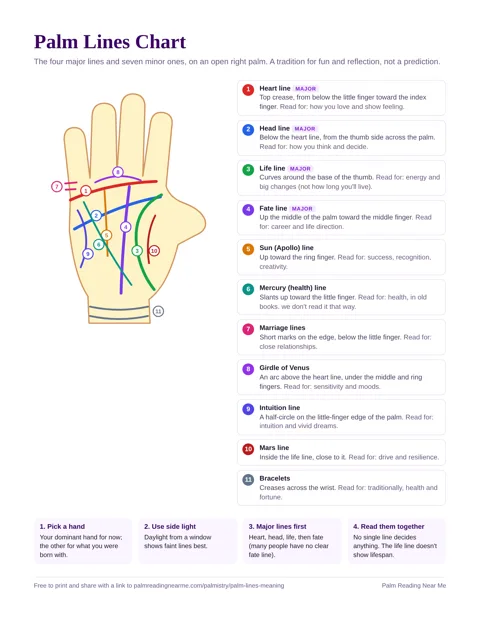
Free printable Palm Lines Chart: all 11 lines on one letter-size page, with a four-step reading guide.
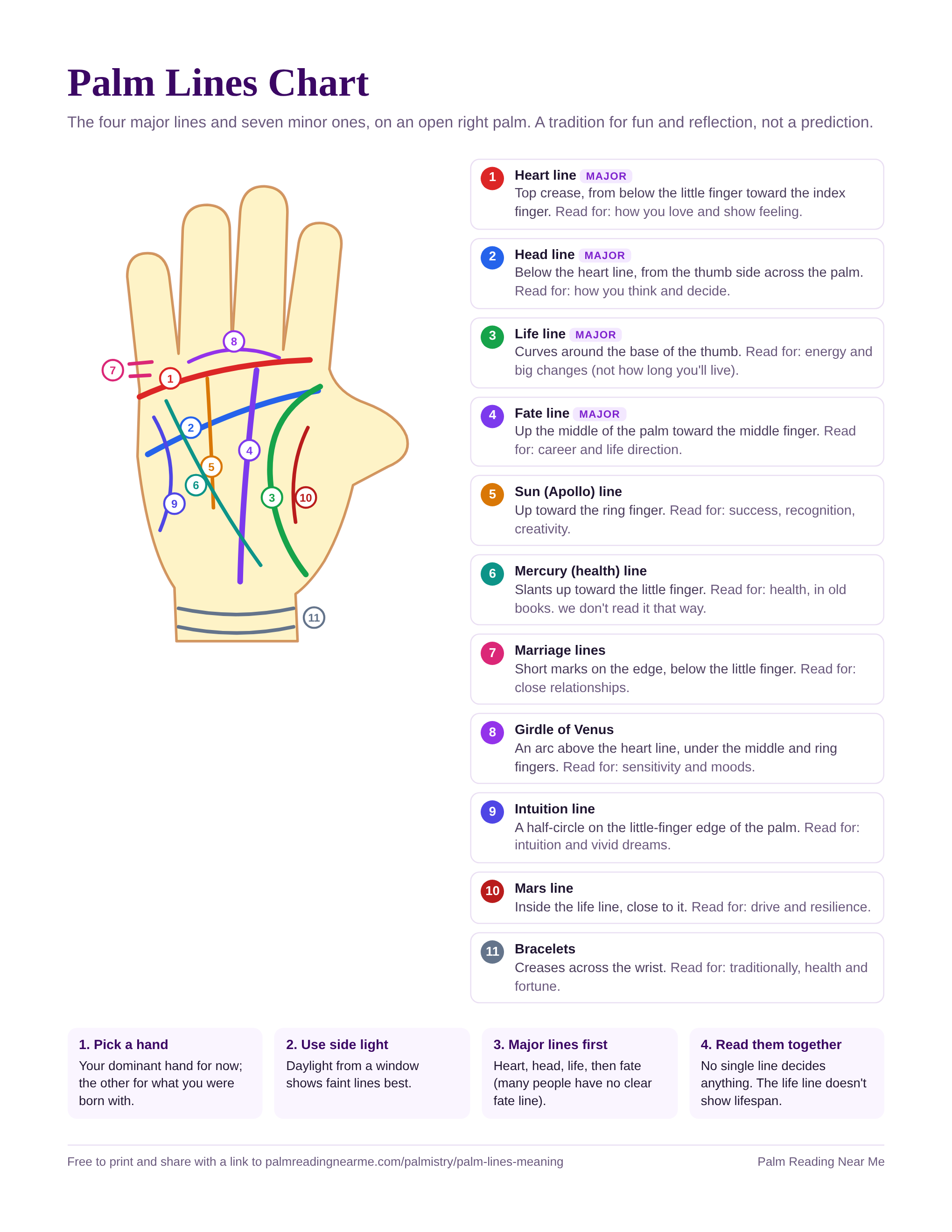
Free to print, share and use in classes or blog posts, with a link back to this page.
Related terms
- Chiromancy: reading the lines of the palm (Cheiro spelled it “cheiromancy”).
- Chirognomy: reading the shape of the hand and fingers.
- Mounts: the padded areas at the base of the fingers and thumb, each named after a planet. The heart line runs under the mounts of Jupiter, Saturn, the Sun and Mercury.
- Simian line or single palmar crease: the heart and head lines joined as one crease.
- Major and minor lines: the four main lines, and the smaller ones that vary from hand to hand.
How we checked this
Every quote from Cheiro was checked word for word against the Project Gutenberg text of Palmistry for All. The Almanac.com and LoveToKnow quotes were checked against their pages as published on November 19, 2026. The fact about when creases form comes from StatPearls; the single crease figures come from Nicklaus Children's Hospital. Want a reader's take on your own hand? Find palm readers near you.
Looking for a reader near you? Compare prices and ask the right questions first.
Find palm readers near meFrequently asked questions
›What are the 4 main lines on your palm?
The heart line (the top crease, read for feeling), the head line (below it, read for thinking style), the life line (curving around the thumb, read for energy and change) and the fate line (up the middle, read for career). Many people have a faint fate line or none at all.
›Which palm line is the most important?
It depends on the reader. Cheiro called the head line “the most important line on the hand.” Many modern readers start with the heart line or the life line. All of them read the lines together, not one alone.
›Does the life line show how long you'll live?
No. Cheiro believed it did, but modern palmists, including Almanac.com and LoveToKnow, say it doesn't, and there's no evidence it could. It's a skin crease that forms before birth. Palmists today read it for energy and changes in direction.
›What does it mean if I don't have a fate line?
Nothing alarming. Many people have no clear fate line. Readers disagree on what it means: Cheiro wrote of “very colourless lives,” while Almanac.com reads it as a future shaped by hard work rather than fate.
›Where are the marriage lines on your hand?
On the outer edge of the palm, below the little finger and above the heart line, as short horizontal marks. Modern readers read them as close relationships in general. They don't count or predict marriages.
›What does it mean when the heart and head lines are joined?
That's a single palmar crease. About 1 in 30 people have one, and Nicklaus Children's Hospital says it's completely normal in most cases. Palmists often read it as intense focus. If you have a medical question about a crease, ask a doctor.
›Can I print the palm lines chart?
Yes. The chart on this page is free to print and share as a PDF or an image, including in classes and blog posts, with a link back to this page.
Sources
- Palmistry for All, by Cheiro (Project Gutenberg plain text) (Project Gutenberg)
- Embryology, Hand (StatPearls) (NCBI Bookshelf)
- Simian Crease (STPC) (Nicklaus Children's Hospital)
- How To Read Palms: A Beginner's Guide to Palmistry (Almanac.com)
- Decoding Your Future: A Guide to Palm Line Reading (LoveToKnow)
Palmistry is presented here as a cultural tradition and for entertainment. It isn't a way to predict events, diagnose health or make decisions about money or relationships.