
Marriage Line Meaning in Palm Reading: Every Shape, and What the Old Books Said
Sources include:
 NCBI Bookshelf
Quick answer
The marriage line is one or more short creases on the edge of the palm, under the little finger and above the heart line. Palmists read it for close relationships, not legal marriages. A long, clear line is read as a lasting bond and a short one as a meaningful connection. It can't predict a marriage, a divorce or a partner's health.
The marriage line isn't one line. It's the short creases, often two or three, that start on the outer edge of the hand under the little finger and run a little way into the palm, above the heart line. Palmists also call them relationship lines or lines of affection, and most read them for close relationships of any kind, not only marriages.
We present palmistry as a cultural tradition and as entertainment. These lines are skin creases. Palm creases form before birth, between about 10 and 13 weeks of pregnancy, according to StatPearls. They can be a fun, reflective way to talk about love. They can't tell anyone whether or when they'll marry.
- Where: the edge of the hand under the little finger. Cheiro called it “the side of the Mount under the fourth finger.”
- Which way: short marks running across, from the edge toward the palm. Some stay on the edge; some run onto the palm.
- Position: Cheiro read a line close to the heart line as “early in life.” He gave no age scale.
How to find your marriage lines
- Use your dominant hand (the one you write with). Palmists read it for the life you've made; many compare both hands.
- Turn your hand sideways with the little finger toward you, and curl the fingers in slightly. The lines sit mostly on the edge, so they're easy to miss from the front.
- Find the heart line, the top long crease across the palm. The marriage lines are above it, between it and the base of the little finger.
- Look for short, horizontal creases that start on the edge. Count only clear ones; skin folds that appear only when you bend the hand are not lines.
- Use side light. Daylight from a window, or a phone light held to one side, makes shallow creases show.
What the number of lines means: three old books disagree
The most common question is what it means to have one, two or three marriage lines. We went back to three public-domain palmistry books and quoted them exactly. They don't agree.
1895
Indian Palmistry
Mrs. J. B. Dale
The number of lines:
“These, according to their number, denote the number of husbands or wives should the widow line also appear; without it they may mean lovers.”
1916
Palmistry for All
Cheiro
The number of lines:
“Only the clearly formed lines relate to marriage, the short ones to deep affection, or marriage contemplated, but never entered into.”
1927
What You Should Know About Palmistry
Leo Markun
The number of lines:
“Each line means a separate love partner. A long and faithful marriage is shown by a single deep line.”
Mrs. J. B. Dale's Indian Palmistry (1895) counts husbands or wives, but only if another sign she calls the "widow line" is there; otherwise, lovers. Cheiro's Palmistry for All (1916) counts only the clearly formed lines as marriages and reads short ones as "deep affection, or marriage contemplated, but never entered into." Leo Markun's What You Should Know About Palmistry (1927) reads each line as a separate love partner, and he ends several of his readings with "So the story is told."
So, by the classic books themselves, the number of lines is not a count of marriages. Modern readers mostly follow Cheiro: a clear line for a relationship that shaped you, short ones for connections that mattered. Having no clear line is common, and it doesn't mean you won't marry.
Position: early or late?
Cheiro read position as timing: "When the deep line is found lying close to the line of Heart, the marriage will take place early in life." He gave no age scale. For dates, he sent readers to other signs: fine "influence lines" joining the fate line.
Many guides today print age charts for the marriage lines, such as a line halfway up meaning a marriage at a certain age. None of the three books we checked gives one, so we don't. If a reader names an age from this line, treat it as a guess.
Every shape, and how to read it today
Cheiro described the shapes in detail, and some of his readings are frightening. He tied a line that droops down to which partner will die first, and a chained line to a warning "not to marry at any time." We show his exact words so you know the tradition, and next to each one, a way to talk about it that's honest and kind.
Long, straight and clear
Cheiro: “For a happy marriage the lines on the Mount of Mercury should be straight and clear.”
Today: Read as a steady, committed bond. Ask: “Is there one relationship that has shaped you most?”
Short or faint
Cheiro: “the short ones to deep affection, or marriage contemplated, but never entered into.”
Today: Read as a close connection that mattered, married or not. Very common.
Curves down toward the heart line
Cheiro: “the person on whose hand this appears will outlive the other.”
Today: Cheiro read lifespan here. No crease can show that, so we don't. Talk about how the person cares for others instead.
Curves up toward the little finger
Cheiro: “the possessor is not likely ever to marry.”
Today: Plenty of married people have this shape. Read it as independence: someone who chooses their own path in love.
Forked at the end
Cheiro: “the two people will live apart from one another.”
Today: Read as two people who keep their own lives and space. Ask how they balance together and apart.
An island (a small loop)
Cheiro: “some great trouble and separation will take place about the middle of the married life.”
Today: Read as a hard stretch that was worked through. Every long relationship has one.
Broken in the middle
Cheiro: “it foreshadows a fatality or break-up in an otherwise happy married life.”
Today: Read as a change of direction, not an ending. Never tell anyone a break means loss.
Chained (a row of islands)
Cheiro: “the subject should be warned not to marry at any time.”
Today: We'd never tell anyone not to marry because of a crease. Read it as a lot of feeling, and ask what they want from love.
Runs on to meet the sun line
Cheiro: “it promises that its possessor will marry some one of great wealth or distinction.”
Today: A fun one to share. Read it as a partner who brings out your best or helps you shine.
Myths about the marriage line
| What people say | What the books and the facts say |
|---|---|
| The number of lines is the number of marriages. | Only Dale (1895) counted marriages, and only with another sign present. Cheiro and Markun read them differently. |
| No marriage line means you'll never marry. | Cheiro gave that reading to a line that turns up, not to having no line. Faint or missing lines are common. |
| A fork means divorce. | Cheiro read a fork as two people living apart; he tied divorce only to a fork turning sharply down into the palm. Either way, a crease can't predict a divorce. |
| Women and men read it differently. | None of the three books gives the marriage line a different meaning by sex. Dale (1895) did choose the hand by sex: "the right palm of the male and the left palm of the female." Most readers today use the dominant hand. |
| The line appears when you meet someone. | None of the three books says so, and palm creases form before birth. |
For palm readers: how to talk about it
The marriage line is where clients ask the most personal questions, and where a careless reading can hurt.
- Never predict a divorce, a death, an illness or "no marriage." Cheiro did all four. Your client may take it to heart for years.
- Ask, don't tell. "This clear line is often read as a relationship that shaped you. Does that sound right?" lets the person lead.
- Read it with the heart line. Cheiro himself said the marriage lines should be read with "the other marks on the hand that qualify these Lines of Marriage."
- Don't charge to "fix" a line. A reader who says a line shows a curse on your love life that money can lift is running a known scam. Our psychic scam warning signs list how it works.
Read the transcript
Where is your marriage line? Turn your hand sideways. Look at the edge, just under your little finger. The short lines running in, above the heart line, are the marriage lines. What does the number of lines mean? Three classic books disagreed. 1895, Mrs. J. B. Dale: the number of husbands or wives, or else lovers. 1916, Cheiro: only the clear lines mean marriage; short ones mean deep affection. 1927, Leo Markun: each line is a separate love partner. Same lines, three meanings. They're a tradition, not a count, and they can't predict a marriage. The free marriage line chart is at palmreadingnearme.com.
The free Marriage Line Chart
Nine shapes, Cheiro's exact words for each, and a kinder way to read it. Print it for a reading room or a class, or share the image with a link back to this page.
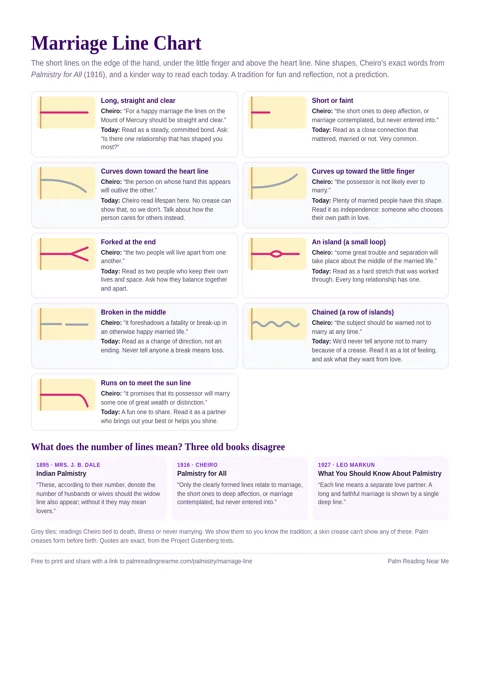
The Marriage Line Chart: nine shapes, Cheiro's exact words, and how to read each one today. Free to print, share and use in a class or reading room.
Free to share with a link back to this page.
Where to go next
- Every line on one chart: palm lines meaning.
- The line the marriage lines sit above: the heart line.
- Reading a whole hand, step by step: how to read palms.
- A reading in person: palm readers near you in our directory.
Looking for a reader near you? Compare prices and ask the right questions first.
Find palm readers near meFrequently asked questions
›Where is the marriage line on your hand?
On the outer edge of the palm, below the little finger and above the heart line. It's usually one to three short horizontal creases that start on the edge. Turn your hand sideways to see them.
›What does it mean if you have two marriage lines?
It depends on which book you ask. Dale (1895) counted husbands or wives only with another sign present, Cheiro (1916) read only clear lines as marriages and short ones as deep affection, and Markun (1927) read each line as a love partner. Most readers today read two lines as two relationships that mattered, not two marriages.
›What if I don't have a marriage line?
It's common, and it doesn't mean you won't marry. Cheiro gave his "not likely ever to marry" reading to a line that turns upward, not to having no line, and we don't read that shape that way either.
›Can the marriage line tell when I'll get married?
No. Cheiro read a line close to the heart line as "early in life" but gave no age scale, and none of the three classic books we checked has one. Palm creases form before birth, so they can't predict a date.
›Does a broken or forked marriage line mean divorce?
Cheiro read a fork as two people living apart and a break as a break-up, but a skin crease can't predict a divorce. Readers today usually read a fork as two people who keep their own space, and a break as a change of direction.
›Which hand do you read for the marriage line?
Most palmists today read the dominant hand, the one you write with, and compare it with the other. Mrs. J. B. Dale (1895) read the right hand for men and the left for women, but none of the three classic books we checked gives the marriage line itself a different meaning by sex.
Sources
- Palmistry for All, by Cheiro, chapter VIII (Project Gutenberg plain text) (Project Gutenberg)
- Indian Palmistry, by Mrs. J. B. Dale (Project Gutenberg plain text) (Project Gutenberg)
- What You Should Know About Palmistry, by Leo Markun (Project Gutenberg plain text) (Project Gutenberg)
- Embryology, Hand (StatPearls) (NCBI Bookshelf)
Palmistry is presented here as a cultural tradition and for entertainment. It isn't a way to predict marriage, divorce, health or any other event, or to make decisions about relationships.
More guides
Palmistry
Sun Line (Apollo Line) Meaning: Where It Starts, and What the Old Books Said
Palmistry
Palm Lines Meaning: A Chart of All 11 Lines
Palmistry
How to Read Palms: A Beginner's Guide, Step by Step
Palmistry
Heart Line Meaning in Palm Reading: What Palmists Say
Guides
How to Spot a Psychic Scam: Warning Signs and What to Do
Guides
Is Fortune Telling Legal? Palm Reading Laws by State and City