Can Science Prove Palmistry? What Science Still Can't Explain

Quick answer
No, science hasn't proven palmistry, and no study has shown that palm lines predict events. But science hasn't proven a great many things. NASA says scientists don't know what about 95% of the universe is made of. There's room to treat a reading as a source of reflection and intuition, alongside what science knows.
No, science hasn't proven palmistry. No study we know of has shown that the lines on a hand predict what will happen in someone's life, and we won't pretend otherwise. But "not proven" is a smaller statement than it sounds. Science hasn't proven a great many things yet, including what most of the universe is made of.
This guide is for anyone who loves palmistry and has heard "but it isn't scientific." It explains what science can and can't test, walks through six big questions science still hasn't answered, and looks at what researchers have found about intuition. It ends with how to hold palmistry and science together, without giving up either.
What science can test, and what it can't
Science is a method for testing ideas against evidence. It works best on questions with a measurable answer: does this medicine lower blood pressure, does this bridge hold this weight. You make a prediction, collect data and see whether the prediction holds.
That makes science very good at some questions and quiet on others. It can test whether a line predicts a specific event. It's far less equipped to measure whether a reading helped you understand yourself, felt meaningful, or gave you the courage to make a change. Those things are real to the people who experience them. They're just hard to put in a test tube.
Even mathematics, the most exact of the sciences, has limits on what proof can do. In 1931 Kurt Gödel showed that in any consistent formal system that can do a certain amount of arithmetic, as the Stanford Encyclopedia of Philosophy puts it, "there are statements of the language of F which can neither be proved nor disproved in F." That's about proof inside a given system, not a license to believe anything. But it's a beautiful reminder that proof itself has edges.
Six big questions science hasn't answered
Here are six open questions, one from each corner of science, each in the words of the institution that studies it.
Astrophysics
What is most of the universe made of?
“While scientists have measured that dark matter makes up about 27% of the cosmos, they're not sure what it is.”
NASA Science
Physics
How does gravity fit with quantum theory?
“No one has managed to make the two mathematically compatible in the context of the Standard Model.”
CERN
Chemistry and biology
How did life begin?
“How life got started on Earth is a mystery.”
NASA Astrobiology
Neuroscience
How does the brain give rise to awareness?
“There have been a number of advances in the search for the neural correlates of consciousness”
Koch, Massimini, Boly & Tononi, Nature Reviews Neuroscience, 2016
Medicine
Why can expecting to feel better help you feel better?
“The placebo effect is a beneficial health outcome resulting from a person's anticipation that an intervention will help.”
NCCIH, National Institutes of Health
Mathematics
Can one system settle every statement by proof?
“there are statements of the language of F which can neither be proved nor disproved in F.”
Stanford Encyclopedia of Philosophy, on Gödel's first incompleteness theorem
| Field | The open question | What the source says |
|---|---|---|
| Astrophysics | What is most of the universe made of? | NASA: about 27% is dark matter, and scientists are "not sure what it is"; about 68% is dark energy, which they know "even less" about |
| Physics | How does gravity fit with quantum theory? | CERN: "No one has managed to make the two mathematically compatible" |
| Chemistry and biology | How did life begin? | NASA Astrobiology: "How life got started on Earth is a mystery" |
| Neuroscience | How does the brain give rise to awareness? | A 2016 review describes the search for the "neural correlates of consciousness" as ongoing, with progress and problems |
| Medicine | Why does expecting to feel better help? | NIH's NCCIH: the placebo effect is "a beneficial health outcome resulting from a person's anticipation that an intervention will help" |
| Mathematics | Can one system settle every statement by proof? | Gödel: some statements can be "neither proved nor disproved" within a given system |
The biggest of these is the first. Everything we can see, every star, planet and person, is "normal matter," and NASA says it makes up less than 5% of the universe. Dark energy (about 68%) and dark matter (about 27%) make up the other 95%, and science doesn't yet know what either one is.
Dark energy 68%
"scientists know even less about it than they do about dark matter"
Dark matter 27%
"they're not sure what it is"
Normal matter 5%
Everything we can directly observe
None of this means palmistry is secretly proven. It means that "science hasn't explained it" is true of a great deal of reality, including the universe we live in. A sense of wonder isn't anti-science. Most scientists would tell you it's why they started.
When science changed its mind
Science is at its best when it updates. Two famous examples show how ideas once dismissed by experts became textbook fact.
In 1915 Alfred Wegener proposed that the continents move. According to the U.S. Geological Survey, his theory was "severely attacked from the start and never gained acceptance in his lifetime." His ideas later became the framework for plate tectonics, "three decades later."
In 1982 Barry Marshall and Robin Warren found the bacterium Helicobacter pylori. At the time, the Nobel Prize committee recalls, "stress and lifestyle were considered the major causes of peptic ulcer disease." The two won the 2005 Nobel Prize for showing the bacterium causes most ulcers.
Moving continents
1915
Alfred Wegener publishes his theory of continental drift.
The view then: “severely attacked from the start and never gained acceptance in his lifetime”
1960s
His ideas become the framework for plate tectonics, "three decades later".
USGS, This Dynamic EarthStomach ulcers
1982
Marshall and Warren find the bacterium Helicobacter pylori.
The view then: “stress and lifestyle were considered the major causes of peptic ulcer disease”
To be fair to science, both ideas won because new evidence arrived; that's the system working. The lesson isn't that every dismissed idea will be vindicated. It's that today's certainty is a snapshot, and humility suits experts and seekers alike.
Intuition: what researchers have found
Palm readers often talk about intuition: a sense that arrives before the reasons do. Science has looked at that too.
In a well-known 1997 study in Science, people played a card game with hidden good and bad decks. The researchers reported that "Normals began to choose advantageously before they realized which strategy worked best," and that their skin responses flagged risky choices before they could say why. Their conclusion: "nonconscious biases guide behavior before conscious knowledge does."
Not everyone agrees on how unconscious that hunch was. A 2004 study in PNAS found that "participants have much more knowledge about the game than previously thought." The debate is still open.
The finding
1997 · Bechara, Damasio, Tranel & Damasio · Science
“Normals began to choose advantageously before they realized which strategy worked best”
“The results suggest that, in normal individuals, nonconscious biases guide behavior before conscious knowledge does.”
The challenge
2004 · Maia & McClelland · PNAS
“By using more sensitive methods, we show that participants have much more knowledge about the game than previously thought.”
What both sides accept is that people often sense a pattern before they can put it into words. A good palm reading can work that way too: a quiet moment of attention in which you notice something about yourself you already half knew.
How to hold palmistry and science together
You don't have to choose between a love of palmistry and respect for science. Many people hold both.
- Let science answer science questions. For health, money and legal decisions, use evidence and professionals. A palm reader worth seeing will tell you the same.
- Let palmistry do what it does well. It's a centuries-old language for character, relationships and choices. Use a reading to reflect, and to listen to your intuition.
- Stay curious in both directions. Ask your reader how they read a line, and read about the open questions above. Wonder is the thread between them.
- Never pay to remove a "curse." That's a scam, not palmistry. See our psychic scam warning signs.
For the history, the studies on palm creases and what a reading can offer, read our guide is palm reading real?
Read the transcript
Can science prove palmistry? Not yet. But science can't explain everything. About 95% of the universe is dark energy (68%) and dark matter (27%). NASA says scientists aren't sure what dark matter is, and know even less about dark energy. Questions science hasn't answered: how gravity fits with quantum theory (CERN), how life began (NASA Astrobiology), how the brain creates awareness (Nature Reviews Neuroscience, 2016), and whether one system can prove every true statement (Gödel, 1931). Science changes its mind: continental drift was severely attacked from the start in 1915 and became plate tectonics in the 1960s (USGS). Ulcers were blamed on stress and lifestyle until H. pylori was found in 1982; its discoverers won the Nobel Prize in 2005. Intuition in the lab: in a 1997 study in Science, people began choosing well before they knew why, and their skin responses flagged risky choices first. Still debated: a 2004 study found players knew more than first thought. Keep an open mind. Science and wonder belong together. The free one-page guide is at palmreadingnearme.com.
The free one-page guide
Six great mysteries of science, the universe in one ring chart and two times science changed its mind, on one printable page with every source.
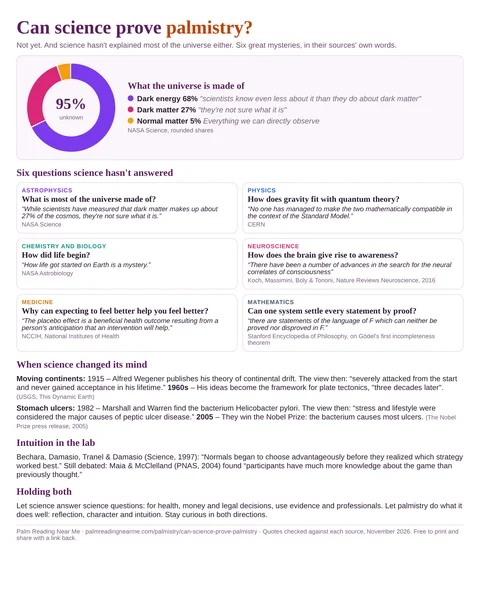
Six great mysteries of science on one page, with the sources. Free to print and share.
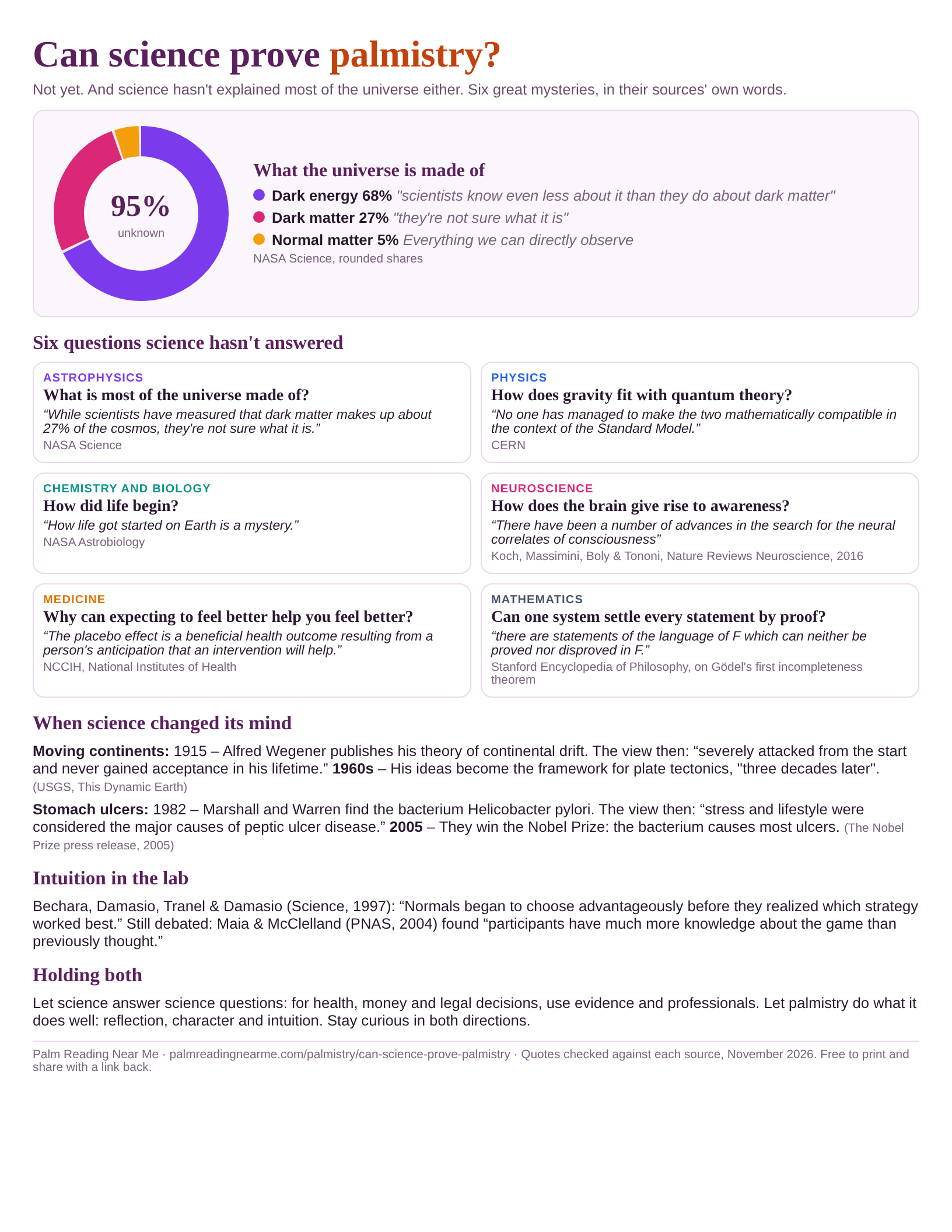
Free to share with a link back to this page.
How we checked this
Every quote comes from its source, read on November 22, 2026: NASA Science, NASA Astrobiology, CERN, the Nobel Prize press release, the U.S. Geological Survey, the Stanford Encyclopedia of Philosophy and the NIH's NCCIH, plus PubMed abstracts read through NCBI's official E-utilities API. Percentages are NASA's rounded figures. Spotted something we should add? Tell us.
Where to go next
- What a reading can offer, and what researchers have looked at: is palm reading real?
- Reading your own palm: how to read palms.
- What each line means in the tradition: palm lines meaning.
- A reader near you: our directory.
Looking for a reader near you? Compare prices and ask the right questions first.
Find palm readers near meFrequently asked questions
›Can science prove palmistry?
Not so far. No study has shown that palm lines predict events. Science also hasn't explained a great many things, including what about 95% of the universe is made of, so many people treat a reading as a source of reflection and intuition rather than a scientific claim.
›Is palmistry a science?
No, it's a tradition, not a science. Palmistry is a centuries-old practice for exploring character and choices, while science tests predictions against data. Both can be valuable; they answer different kinds of questions.
›Does science explain everything?
No. NASA says scientists don't know what dark matter or dark energy are, CERN says gravity and quantum theory haven't been made to fit together, and NASA calls the origin of life a mystery. Science is a powerful method that is still in progress.
›Is intuition real?
People often sense a pattern before they can explain it. In a 1997 study in Science, players began choosing well in a card game before they knew why, though a 2004 study argued they knew more than first thought. Researchers still debate how unconscious that hunch is.
›Has science ever been wrong about something?
Yes, and it corrected itself. Continental drift was attacked when Alfred Wegener proposed it in 1915 and later became the basis of plate tectonics. Stomach ulcers were blamed on stress until H. pylori was found in 1982; its discoverers won a Nobel Prize in 2005.
›Should I make big decisions from a palm reading?
Use a reading for reflection, not as your only guide. For health, money or legal decisions, talk to a doctor, financial adviser or lawyer, and treat a reading as one more way of thinking things through.
Sources
- Building Blocks (what the universe is made of) (NASA Science)
- The Standard Model (CERN)
- How did life first emerge on Earth? (NASA Astrobiology)
- Neural correlates of consciousness: progress and problems (Koch, Massimini, Boly & Tononi, 2016) (PubMed, U.S. National Library of Medicine)
- Placebo Effect (National Center for Complementary and Integrative Health (NIH))
- Gödel's Incompleteness Theorems (Stanford Encyclopedia of Philosophy)
- Alfred Lothar Wegener: Moving continents (This Dynamic Earth) (U.S. Geological Survey)
- The Nobel Prize in Physiology or Medicine 2005: press release (The Nobel Assembly at Karolinska Institutet)
- Deciding advantageously before knowing the advantageous strategy (Bechara et al., Science, 1997) (PubMed, U.S. National Library of Medicine)
- A reexamination of the evidence for the somatic marker hypothesis (Maia & McClelland, PNAS, 2004) (PubMed, U.S. National Library of Medicine)
Palmistry is a cherished tradition, offered here for reflection and entertainment. It isn't a substitute for medical, financial or legal advice.
More guides
Palmistry
Is Palm Reading Real? What a Reading Can Offer You
Palmistry
Palmistry and Astrology: The Seven Planets in Your Hand
Palmistry
Sun Line (Apollo Line) Meaning: Where It Starts, and What the Old Books Said
Palmistry
Marriage Line Meaning in Palm Reading: Every Shape, and What the Old Books Said
Palmistry
Palm Lines Meaning: A Chart of All 11 Lines
Palmistry
How to Read Palms: A Beginner's Guide, Step by Step
Palmistry
Heart Line Meaning in Palm Reading: What Palmists Say
Guides
How to Spot a Psychic Scam: Warning Signs and What to Do
Guides
Is Fortune Telling Legal? Palm Reading Laws by State and City