Palm Reading vs Tarot vs Astrology: Which Reading Is for You?

Quick answer
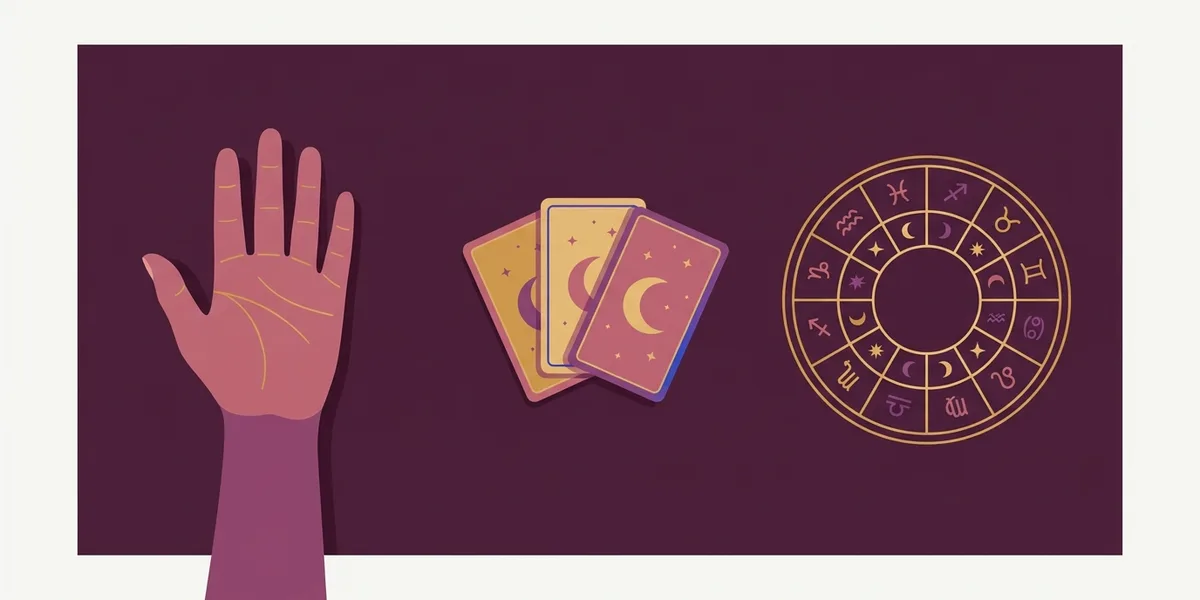
Palm reading looks at your hands to explore your character and the shape of your life. Tarot reads cards you draw for a specific question, so it suits a decision you're facing now. Astrology reads your birth chart, made from your birth date, time and place. Choose by what you want to explore.
Palm reading, tarot and astrology all offer a way to step back and look at your life, but each starts from a different place. A palm reader looks at your hands. A tarot reader lays out cards you draw for a question. An astrologer reads a chart of the sky at the moment you were born. Which one suits you depends on what you want to explore.
If you're drawn to all three, you're not alone. A 2025 Pew Research Center survey found that 30% of American adults consult astrology, tarot cards or a fortune teller at least once a year. This guide compares them side by side, walks one question through all three, and helps you choose your first reading.
Palm reading, tarot and astrology side by side
Palm reading
- What the reader looks at
- The lines, mounts, fingers and shape of your hands
- What you bring
- Your hands (both of them)
- Does it change?
- Slowly: the same hands, read again over years
- Best for
- Your character, strengths and the shape of your life
- In person or online
- Best in person, where the reader can see and hold your hands
Tarot
- What the reader looks at
- Cards you draw from a deck of 78, laid out in a spread
- What you bring
- A question, or just an open mind
- Does it change?
- Every reading: the cards are shuffled each time
- Best for
- A specific question or decision right now
- In person or online
- Works well either way
Astrology
- What the reader looks at
- Where the sun, moon and planets were when you were born
- What you bring
- Your birth date, time and place
- Does it change?
- Your birth chart never changes; readers compare it with the sky now
- Best for
- Your temperament and the seasons of your life
- In person or online
- Works well either way; a chart can be drawn from your details
| Palm reading | Tarot | Astrology | |
|---|---|---|---|
| What the reader looks at | Your hands: lines, mounts, fingers, shape | Cards drawn from a deck of 78 | Your birth chart |
| What you bring | Your hands | A question, or an open mind | Birth date, time and place |
| Does it change? | Slowly, over years | Every reading | Your chart never changes |
| Best for | Character and the shape of your life | A specific question now | Temperament and life's seasons |
| In person or online | Best in person | Either | Either |
The short version: palm reading is about who you are, tarot is about the question in front of you, and astrology is about your nature and timing.
What each tradition looks at
Palm reading reads the hand itself: the major lines (heart, head, life and fate), the mounts named after the planets, the fingers and the hand's overall shape. Readers usually look at both hands. The palmist Cheiro explained why in Palmistry for All (1916): the active hand "denotes the developed or active brain, the left only giving the natural tendencies or inclinations." In other words, one hand shows what you were born with and the other what you've made of it. Our palm lines chart covers every line.
Tarot uses a deck of 78 cards: 22 picture cards, the Major Arcana (Waite calls them the "twenty-two Trumps Major"), and four suits of 14 cards each, the Minor Arcana. A. E. Waite's classic guide to the tarot describes a ten-card spread and says plainly what it's for: "This mode of divination is the most suitable for obtaining an answer to a definite question." Each card's meaning depends on where it falls in the spread.
Astrology starts from your birth chart: a map of the sky at the moment and place you were born. Sepharial's classic guide puts the idea in one line: astrology looks for a connection between "the disposition of the heavenly bodies at the moment of a birth" and the life of the person born. That's why an astrologer asks for your birth time, not just your birthday. The planets that name the palm's mounts are the same planets in your chart; our guide to palmistry and astrology shows how the two connect.
Palm reading
Palmistry for All · Cheiro, 1916
“it is this hand which denotes the developed or active brain, the left only giving the natural tendencies or inclinations.”
Why palmists read both hands, with the right (for right-handed people) as the one you've grown into.
Tarot
The Illustrated Key to the Tarot (Waite's text) · A. E. Waite, reprinted by L. W. de Laurence, 1918
“This mode of divination is the most suitable for obtaining an answer to a definite question.”
Waite introducing his ten-card spread: tarot is built around a question.
Astrology
Astrology: How to Make and Read Your Own Horoscope · Sepharial, 1920
“the disposition of the heavenly bodies at the moment of a birth”
Why an astrologer asks for your birth time: the chart is a picture of that moment.
One question, three readings
The clearest way to see the difference is to bring the same question to all three. Here's how each kind of reader would usually approach "Should I take the new job?" It's an illustration of each method, not a real reading.
“Should I take the new job?”
Palm reading
- 1Looks at both hands, then your dominant one
- 2Reads the head line for how you think and decide
- 3Reads the fate line for how you approach work and direction
- 4Talks through what suits your nature
Tarot
- 1Asks you to hold the question while you shuffle
- 2Lays out a spread, often ten cards in Waite's method
- 3Reads each card in its place: the situation, what helps, what's in the way
- 4Talks through the choice the cards frame
Astrology
- 1Draws your chart from your birth date, time and place
- 2Looks at the Tenth House, which Sepharial says "rules over position, honour and fame"
- 3Compares your chart with where the planets are now
- 4Talks through timing and temperament
- A palm reader studies both hands, then reads your head line for how you think and decide, and your fate line for how you approach work and direction. The conversation is about what suits your nature.
- A tarot reader asks you to hold the question while you shuffle, lays out a spread and reads each card in its place: the situation, what helps you, what stands in the way. The cards frame the choice.
- An astrologer draws your chart and looks at the Tenth House, which Sepharial says "rules over position, honour and fame," then compares your chart with where the planets are now. The talk turns to timing and temperament.
All three end in the same place: a conversation that helps you see your own situation more clearly. The choice stays yours.
How many people consult each
Astrology is the most popular of the three in the U.S., then tarot. Pew's survey of 9,593 adults found that 28% consult astrology or a horoscope at least once a year, 11% consult tarot cards and 6% consult a fortune teller. Pew didn't ask about palm reading on its own.
30% of U.S. adults consult at least one, at least once a year
20%
do it mostly “just for fun”
10%
do it mostly for “helpful insights”
1%
rely on it “a lot” for major decisions
Most people keep it light: 20% of American adults say they consult these mostly "just for fun," and 10% mostly for "helpful insights." Just 1% say they rely on them "a lot" when making major life decisions. That's a healthy way to enjoy any reading: as reflection and inspiration, alongside your own judgment.
Where each one shines
Choose palm reading if you want a reading about you as a person: your strengths, how you love, how you think. It needs nothing but your hands, it's personal and tactile, and you can learn to read your own. Start with how to read palms.
Choose tarot if you have a specific question or a decision on your mind. Tarot is built around a question, it's different every time, and it works as well online as in person.
Choose astrology if you're curious about your temperament and the seasons of your life, and you know your birth time.
Combine them if you like. Many readers offer more than one, and palmistry has borrowed from astrology for centuries: the mounts of the hand carry the planets' names.
Our verdict: which reading should you choose?
There's no wrong first choice. If you want to feel seen as a person, start with a palm reading. If you're wrestling with one decision, try tarot. If you love the idea of the sky at your birth, book an astrologer.
Whichever you choose, the best readers share a few habits: they listen, they talk about character and possibility rather than fixed fate, and they never ask for money to remove a "curse." That last one is a scam, not a tradition; see our psychic scam warning signs. For health, money or legal decisions, pair any reading with advice from a doctor, financial adviser or lawyer.
Ready to try one? Find a palm reader or psychic in our directory of readers near you.
Read the transcript
Palm reading, tarot or astrology? What each one reads: palm reading reads your hands, tarot reads a spread of cards, and astrology reads your birth chart. What you bring: your hands for a palm reading; a question for tarot; your birth date, time and place for astrology. Which is best for you? Palm reading for who you are, tarot for a decision you're facing now, astrology for your nature and timing. How many U.S. adults consult each at least once a year: astrology or a horoscope 28%, tarot cards 11%, a fortune teller 6% (Pew Research Center, 2025 survey of 9,593 adults). Find the reading that's right for you: hands, cards or stars, start with what calls to you. Free comparison chart at palmreadingnearme.com.
The free comparison chart
Palm reading, tarot and astrology side by side, plus the Pew numbers and one question walked through all three, on one printable page.
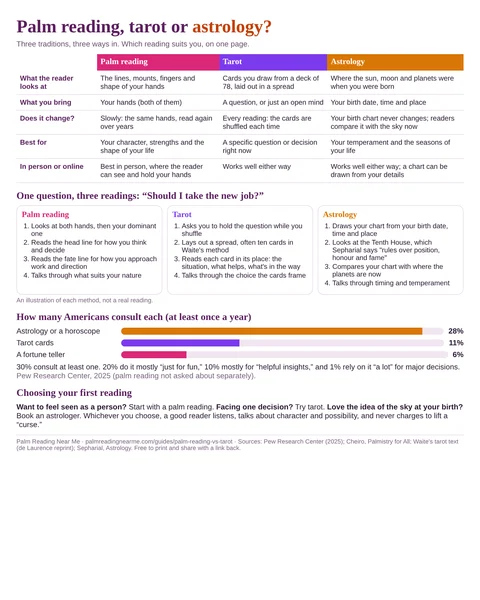
Palm reading, tarot and astrology compared on one page. Free to print and share.
Free to share with a link back to this page.
How we checked this
The survey figures are from Pew Research Center's May 21, 2025 report, read on pewresearch.org on November 23, 2026. Quotes from Cheiro, Sepharial and Waite are copied from the Project Gutenberg texts of their books; Waite's text is quoted from L. W. de Laurence's 1918 reprint of it. Where we describe how readers usually work, we describe each tradition's own method, not a claim about what it can predict.
Where to go next
- What a reading can offer you: is palm reading real?
- The planets in your hand: palmistry and astrology.
- Every line on your palm: palm lines meaning.
- A reader near you: our directory.
Looking for a reader near you? Compare prices and ask the right questions first.
Find palm readers near meFrequently asked questions
›What's the difference between palm reading and tarot?
A palm reader reads your hands: the lines, mounts and shape that stay with you for life. A tarot reader reads cards you draw for a question, so every reading is different. Palm reading suits questions about who you are; tarot suits a specific decision.
›Which is more accurate, palm reading, tarot or astrology?
They aren't measured the same way, and science hasn't shown that any of them predicts events. Most people choose the one whose approach feels meaningful to them: the hands, the cards or the stars. A thoughtful reader matters more than the method.
›Is astrology more popular than tarot?
Yes, in the U.S. Pew Research Center found that 28% of adults consult astrology or a horoscope at least once a year, compared with 11% for tarot cards and 6% for a fortune teller.
›Do I need my birth time for an astrology reading?
For a full birth chart, yes. Astrology reads the sky at the moment and place you were born, so an astrologer will ask for your birth date, time and place.
›Can I get a palm reading online?
You can, using clear photos of both palms, but palm reading works best in person, where the reader can see the lines in good light and feel the hand's shape. Tarot and astrology work just as well online.
›Can palm readers also read tarot?
Many do. Readers often offer palmistry, tarot and astrology together, and palmistry has long borrowed from astrology: the mounts of the hand are named after the planets.
Sources
- 30% of Americans Consult Astrology, Tarot Cards or Fortune Tellers (May 21, 2025) (Pew Research Center)
- Palmistry for All, by Cheiro (Project Gutenberg plain text) (Project Gutenberg)
- The Illustrated Key to the Tarot, by L. W. de Laurence (1918 reprint of A. E. Waite's text; Project Gutenberg plain text) (Project Gutenberg)
- Astrology: How to Make and Read Your Own Horoscope, by Sepharial (Project Gutenberg plain text) (Project Gutenberg)
Palmistry, tarot and astrology are cherished traditions, offered here for reflection and entertainment. They aren't a substitute for medical, financial or legal advice.
More guides
Palmistry
Can Science Prove Palmistry? What Science Still Can't Explain
Palmistry
Is Palm Reading Real? What a Reading Can Offer You
Palmistry
Palmistry and Astrology: The Seven Planets in Your Hand
Palmistry
Sun Line (Apollo Line) Meaning: Where It Starts, and What the Old Books Said
Palmistry
Marriage Line Meaning in Palm Reading: Every Shape, and What the Old Books Said
Palmistry
Palm Lines Meaning: A Chart of All 11 Lines
Palmistry
How to Read Palms: A Beginner's Guide, Step by Step
Palmistry
Heart Line Meaning in Palm Reading: What Palmists Say
Guides
How to Spot a Psychic Scam: Warning Signs and What to Do
Guides
Is Fortune Telling Legal? Palm Reading Laws by State and City