
Simian Line (Single Palmar Crease): What Palmists and Doctors Say
Sources include:
 MedlinePlus, U.S. National Library of Medicine
 Nicklaus Children's Hospital

Quick answer
A simian line is one crease running straight across the palm where the heart and head lines would be. Doctors call it a single palmar crease: about 1 in 30 people have one, and MedlinePlus says it's often normal. Palmists read it as rare intensity, a mind and heart that work as one.
A simian line is one long crease running straight across your palm, where most people have two: the heart line and the head line. Doctors call it a single palmar crease. Palmists have long seen it as a sign of unusual intensity, a person whose mind and heart move together.
It's more common than many people think. MedlinePlus, the U.S. National Library of Medicine's health encyclopedia, says it "appears in about 1 out of 30 people" and that "having a single palmar crease is often normal." This guide covers both sides: what doctors say, then what palmists read.
Three creases
Heart, head and life lines: the usual pattern
One crease across
The single palmar crease (older name: simian line)
How to tell if you have one
- Open your hand with the palm toward you, in good side light.
- Find the life line, the curve around the base of your thumb. It's there whether or not you have a single crease.
- Look above it. Most palms have two long creases across the middle: the heart line on top and the head line below. With a single palmar crease, you'll see one deep line running all the way across instead.
- Check both hands. The crease can appear on one hand or both, and palmists usually read both.
Lots of hands fall in between: a heart line and head line linked by a short crease, or a head line that runs unusually straight and long. Palmists don't usually count those as a true single crease. If you're unsure, that's a nice question to bring to a palm reader.
Why it's called the simian line, and the better name
"Simian" means monkey or ape. MedlinePlus explains that the older term "simian crease" is "not used much anymore, since it tends to have a negative meaning." Doctors now say single palmar crease or transverse palmar crease. Many palmists still say "simian line" because it's the name in the older books, but you'll see us use both. You don't need to feel anything but curious about yours.
How common it is
1 in 30
people
~1 in 23
men
~1 in 45
women
About 1 in 30 people have a single palmar crease, and MedlinePlus says "males are twice as likely as females to have this condition." If there are roughly as many men as women, that works out to about 1 in 23 men and 1 in 45 women. That's our arithmetic from MedlinePlus's two figures, not a separate study. In a room of 30 people, it's likely that one of them has it.
What doctors say
Three creases is usual
“People most often have 3 creases in their palms.”
Forms before birth
Palm creases develop in the womb, “most often by the 12th week of gestation.”
About 1 in 30 people
Men are about twice as likely as women to have one.
Often normal
“Having a single palmar crease is often normal.”
One sign among many
Doctors look at it alongside the family history, medical history and a full exam.
Palm creases form before you're born, "most often by the 12th week of gestation," according to MedlinePlus. In most people, a single crease is just how their hand formed. Nicklaus Children's Hospital puts it plainly: "in most cases, it is completely normal."
Doctors do take note of it in newborns, because a single crease is also more common with some genetic conditions, Down syndrome among them. MedlinePlus is careful about what that means: a baby with the crease "may have other symptoms and signs that, when taken together, define a specific syndrome or condition," and any diagnosis rests on "a family history, medical history, and complete physical exam." In other words, the crease is one small detail a pediatrician looks at alongside everything else. If you have a question about your own hands or your child's, ask a doctor; it isn't something a palm reading can answer.
What palmists say it means
Cheiro, one of the best-known palmists of the early 1900s, wrote about the single crease in Palmistry for All (1916). He described "one clear line running across the hand from side to side," which, he said, "simply denotes tremendous intensity of character, for good or evil as the case may be; such a person would exhibit great power of concentration."
In his chapter on the heart line he put it more warmly: "If such a subject loves, he unites with it all the forces of his mind, and if he put his mind on any subject, he throws his whole heart and soul into whatever it may be."
That's the heart of the modern reading too. Palmists today often describe people with a single crease as:
- Focused: once they choose something, they give it everything.
- All-in, not half-in: in love, work and friendship alike.
- Hard to divide: thinking and feeling come as one, so decisions can feel very personal.
Cheiro's book also attached some gloomy forecasts to this crease, as books of his era often did with unusual marks. We leave those out. No crease can foretell what happens to you, and a reading should leave you feeling understood, not afraid.
Higher or lower: Cheiro's two readings
Here's a detail most modern pages skip. Cheiro told students to look at where the single line sits before reading it: "whether this one line across the hand lies across the centre where the Head Line would naturally be, or whether it lies higher up towards the base of the fingers where the Heart Line is generally found."
Lower: where the head line sits
Cheiro: “it is a question of head and mentality and very little heart”
Today: A thinker first: feelings run through the mind.
Higher: toward the heart line
Cheiro: “it is a question of more intensity of feeling emotion and affection than of mental intensity”
Today: A feeler first: the heart leads the head.
- Lower, where the head line would be: "it is a question of head and mentality and very little heart." A thinker first, whose feelings run through the mind.
- Higher, toward the heart line: "it is a question of more intensity of feeling emotion and affection than of mental intensity." A feeler first, whose heart leads the head.
Try it on your own hand: compare the crease's height with the gap between your fingers and the base of your thumb. Many single creases sit in the middle, and a reader will look at the rest of the hand, too.
One hand or both
Palmists traditionally read the non-dominant hand as what you were born with and the dominant hand as what you've made of it. When the crease is on one hand only, readers often take it as a quality you either grew into or learned to soften. On both hands, they read it as a steady part of who you are.
Read the transcript
One line across your palm? Most palms have three main creases. Sometimes the top two run as one. Doctors call it a single palmar crease. The old name is the simian line. About 1 in 30 people have one, and men about twice as often as women. It forms before birth, and it's often normal. Cheiro said: look where it sits. Lower, the head leads. Higher, the heart leads. A mind and heart that work as one. Free chart at palmreadingnearme.com.
For palm readers: reading it kindly
- Name it gently. "You have a single palmar crease. About 1 in 30 people do." Avoid "simian" with a client who may not know the word.
- Lead with the strength. Intensity and focus are gifts. Ask where the person puts their whole heart.
- Never read it for health. If a client is worried about a medical question, point them to a doctor.
- Skip the old forecasts. No warnings, no fear.
The free Single Palmar Crease card
Two palm drawings, the facts from MedlinePlus, and Cheiro's two readings, on one printable page. Use it in a class or reading room, or share it with a link back to this page.
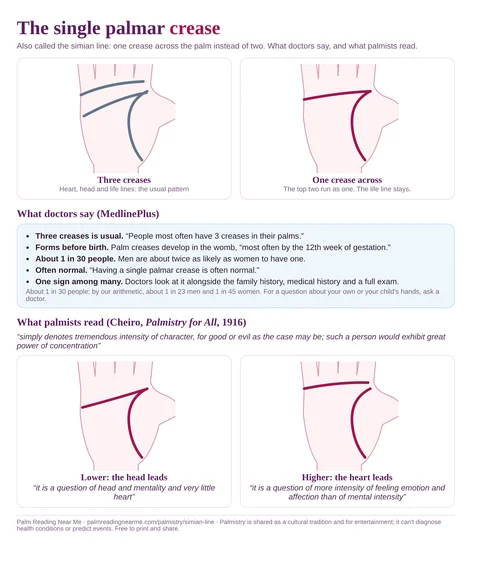
The Single Palmar Crease card: the facts from MedlinePlus on one side, Cheiro's readings on the other. Free to print and share.
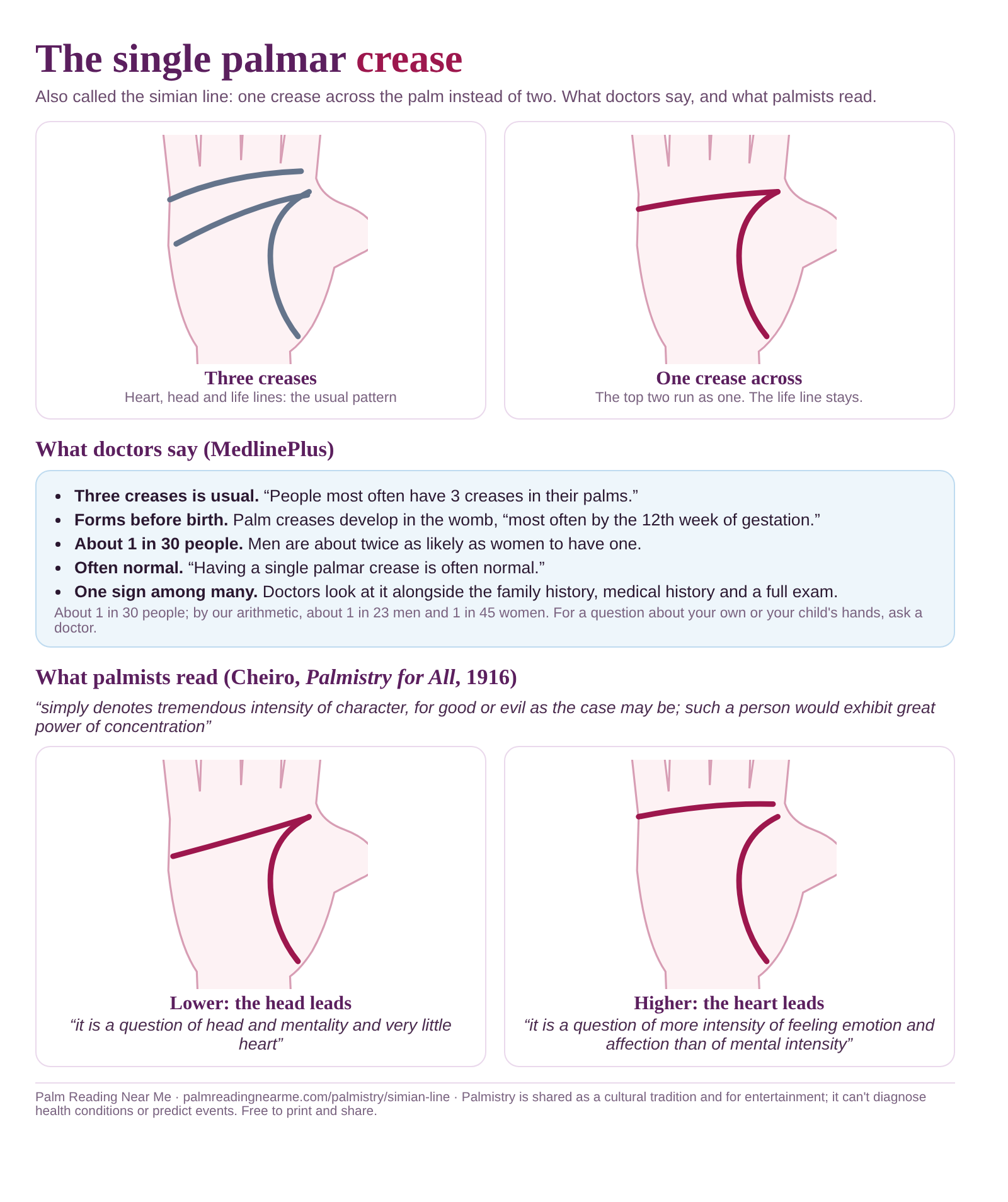
Free to share with a link back to this page.
Where to go next
- Every line on one chart: palm lines meaning.
- The two lines that merge here: the heart line, and the head line on our palm lines chart.
- Reading a whole hand, step by step: how to read palms.
- What science does and doesn't say about palmistry: is palm reading real?
- A reading in person: palm readers near you in our directory.
Looking for a reader near you? Compare prices and ask the right questions first.
Find palm readers near meFrequently asked questions
›What does a simian line mean in palmistry?
Palmists read a single crease across the palm as intensity and focus: a person whose mind and heart work as one. Cheiro wrote that it "denotes tremendous intensity of character" and "great power of concentration." It's a tradition, not a prediction.
›Is having a simian line rare?
Not very. MedlinePlus says about 1 in 30 people have a single palmar crease, and men about twice as often as women. It can appear on one hand or both.
›Is a single palmar crease a sign of a medical problem?
Usually not. MedlinePlus says having one "is often normal." Doctors note it in newborns because it's more common with some conditions, and they read it alongside the family history and a full exam. Ask a doctor if you have a question.
›Why is it called a simian line?
"Simian" means monkey or ape. Doctors now prefer "single palmar crease" because, as MedlinePlus puts it, the older term "tends to have a negative meaning." Palmists often still use the old name from the classic books.
›What if I have a simian line on only one hand?
It happens. Palmists traditionally read the non-dominant hand as your nature and the dominant hand as what you've made of it, so a crease on one hand is read as a quality you grew into or learned to soften.
›Is a simian line lucky or unlucky?
Neither. Old books sometimes attached gloomy forecasts to it, but no crease can predict what happens to you. Today's readers treat it as a sign of focus and wholeheartedness.
Sources
- Single palmar crease (Medical Encyclopedia) (MedlinePlus, U.S. National Library of Medicine)
- Simian Crease (STPC) (Nicklaus Children's Hospital)
- Palmistry for All, by Cheiro (Project Gutenberg plain text) (Project Gutenberg)
Palmistry is presented here as a cultural tradition and for entertainment. It can't diagnose health conditions or predict events. For a medical question about a palm crease, ask a doctor.
More guides
Guides
What to Expect at a Psychic Reading, and Questions to Ask
Guides
Palm Reading vs Tarot vs Astrology: Which Reading Is for You?
Palmistry
Can Science Prove Palmistry? What Science Still Can't Explain
Palmistry
Is Palm Reading Real? What a Reading Can Offer You
Palmistry
Palmistry and Astrology: The Seven Planets in Your Hand
Palmistry
Sun Line (Apollo Line) Meaning: Where It Starts, and What the Old Books Said
Palmistry
Marriage Line Meaning in Palm Reading: Every Shape, and What the Old Books Said
Palmistry
Palm Lines Meaning: A Chart of All 11 Lines
Palmistry
How to Read Palms: A Beginner's Guide, Step by Step
Palmistry
Heart Line Meaning in Palm Reading: What Palmists Say
Guides
How to Spot a Psychic Scam: Warning Signs and What to Do
Guides
Is Fortune Telling Legal? Palm Reading Laws by State and City