
What to Expect at a Psychic Reading, and Questions to Ask


Quick answer
A psychic reading usually lasts a set time at a price agreed up front. The reader explains how they work, you share a question or keep it open, they give their reading, and you ask questions. Go in curious, take notes, and treat it as a chance to reflect, not a forecast.
A psychic reading is a conversation with a reader who uses their intuition, and often a tool such as tarot cards, your palms or your birth chart, to talk about your life and what's on your mind. Most readings follow a simple shape, and knowing it ahead of time makes the experience calmer and more useful.
People come for all kinds of reasons: curiosity, a hard decision, a loss, or simply for fun. However you see it, a good reading leaves you feeling listened to and with something to think about. It can't tell you what will happen, and a good reader won't promise that it can.
How a psychic reading usually works
1. Before
Agree the price and length
One price, stated up front, for a set time. Ask what's included.
2. Start
How the reader works
Cards, palms, a birth chart, or impressions. Ask what to expect.
3. Your question
Say what's on your mind
Or don't: some readers prefer to start open.
4. The reading
Listen, and take notes
Notice what feels true to you, and what doesn't.
5. Your turn
Ask questions
Ask what a symbol means, or how they reached a point.
6. After
Sit with it
Treat it as a reflection, not a forecast. No pressure to rebook.
- Before: agree the price and length. A fair reader tells you one price, up front, for a set amount of time. Ask what's included.
- Start: how the reader works. Many explain their method first: cards, palms, a birth chart, or impressions. Some ask for your name or birth date; some prefer to know nothing.
- Your question. You can share what's on your mind (love, work, a decision, someone you've lost) or let the reader start open.
- The reading. The reader talks through what they see. Listen, take notes if you like, and notice what feels true to you and what doesn't.
- Your turn. Ask questions. It's fine to ask what a card or line means, or how the reader reached a point.
- After. Sit with it. A reading is a prompt for reflection. You should never feel pressured to book again.
Kinds of readings
Psychic
Their own impressions or intuition, often with a tool such as cards
Medium
Says they pass on messages from people who have died
Tarot reader
A spread of cards drawn from a deck of 78
Palm reader
The lines, mounts and shape of your hands
Astrologer
Your birth chart: date, time and place of birth
"Psychic reading" covers several traditions, and many readers offer more than one. If you're choosing between them, our guide to palm reading vs tarot vs astrology compares the three most popular in detail. A palm reading is best in person, where the reader can see and hold your hands; tarot and astrology work well by phone or video, too.
In person, by phone or by video
- In person suits palm readings best, since the reader needs to see and hold your hands. It's also the easiest way to get a feel for a reader before you book again. Our directory lists readers by city.
- By phone or video works well for tarot and astrology: the reader can lay out cards on camera, or draw your chart from your birth date, time and place.
- Online chat or apps are quick, but make sure you know how you're being charged. Per-minute pricing can add up fast, so agree a limit before you start.
Whichever you choose, the same rule applies: know the total price before the reading begins.
If you're grieving
Many people book a reading, often with a medium, after losing someone. That's a deeply personal choice, and for some it brings comfort. Go gently: take a friend if it helps, decide your budget beforehand, and be wary of anyone who says you must pay more to keep hearing from a loved one. A good reader will treat your grief with care and will never use it to sell you more sessions. If grief feels heavy for a long time, a grief counselor or support group can help alongside anything else you find meaningful.
How to prepare
- Think about what you want from it. A specific question, a general check-in, or just the experience? There's no wrong answer.
- Write down one or two questions, so they don't slip away in the moment.
- Bring an open mind and your own judgment. You're allowed to take what resonates and leave the rest.
- Know the price before you sit down, and decide what you're comfortable spending. A reading shouldn't strain your budget.
- Bring a notebook, or ask if you can record. Some readers say yes, some don't; ask first.
Questions to ask
Before you book
- What's the total price, and what does it include?
- How long is the session?
- How do you work: cards, palms, a chart, impressions?
- Are there any other costs later?
During the reading
- What makes you say that?
- What does that card or line mean in your tradition?
- Can you say more about how this fits my question?
- What would you want me to reflect on?
Afterwards, ask yourself
- What stayed with me, and why?
- Did anything feel off, or pushed?
- Would I go back for the experience, not because I was told to?
Good questions keep a reading fair and make it more useful. Before you book, ask about the total price, the length, and how the reader works. During the reading, it's fine to ask "What makes you say that?" or what a symbol means in their tradition; a good reader is glad to explain. Afterwards, ask yourself what stayed with you, and whether anything felt pushed.
Who goes to psychics, and why
You'd be in good company. In a 2024 survey of 9,593 U.S. adults, Pew Research Center found that 30% of Americans consult astrology, tarot cards or a fortune teller at least once a year, and 6% consult a fortune teller specifically. Younger adults are far more likely to go: 14% of adults under 30 consult a fortune teller at least once or twice a year, compared with 2% of those 65 and older.
30%
consult astrology, tarot or a fortune teller at least yearly
14%
do at least one monthly
20% vs 10%
go mostly “just for fun” vs for “helpful insights”
Most people go for enjoyment. Pew found that 20% of U.S. adults engage in these practices mostly "just for fun," and 10% mostly because they believe the practices "give them helpful insights." Few make big decisions on them: just 1% rely on them "a lot" for major life decisions, and another 5% "a little." That's a healthy way to see a reading: as an experience and a mirror, not an instruction.
What to do with what you heard
- Write it down the same day, while it's fresh.
- Notice what resonated, and ask yourself why. Often the most useful part of a reading is the question it leaves you with.
- Let the rest go. Not every point will fit, and that's normal.
- Keep big decisions yours. Use a reading as one voice among many: your own judgment, people you trust, and professionals for health, money or legal questions.
What a good reading feels like
- You understand the price, and it doesn't change.
- You feel heard. The reader responds to you, not to a script.
- It's kind. Hard topics are handled gently.
- It leaves room for you. The reader offers ideas, not orders.
- It ends cleanly. No hints that you need more sessions, or that something bad will happen if you don't come back.
How to keep it fair
Most readers are honest people offering an experience their clients enjoy. A small number aren't, and the U.S. Postal Inspection Service, which investigates fraud that uses the mail, warns that psychic scammers "are good at telling people exactly what they want to hear." Its advice is simple:
Watch out for promises with fees
“Watch out for psychics who guarantee you good health, wealth, or fortune.”
Never give out financial information
“Never give money or credit card or bank account information to anyone you do not know or trust.”
Research the price of services
“If you want to engage the services of a psychic, be sure you know the total cost of anything you order and exactly what you will receive.”
Ask about hidden costs
“Ask if there are any conditions and ongoing or hidden costs.”
Discuss with a friend
“Check with a trusted friend or loved one before engaging the services of a psychic or medium.”
Walk away from talk of curses, offers to "cleanse" money or jewelry, fees that keep growing, or pressure to act fast or keep it secret. Our guide to psychic scam warning signs has the full list and where to report fraud. Fortune-telling laws also vary by state and city; see is fortune telling legal?.
Read the transcript
Your first psychic reading? What to expect, and what to ask. How a reading usually runs: agree the price and length, the reader explains how they work, say what's on your mind, listen and take notes, ask questions, then sit with it. Who goes? 14% of adults under 30 consult a fortune teller at least once a year, 6% of all U.S. adults, and 2% of those 65 and older (Pew Research Center, 2025). Why people go: 20% mostly just for fun, 10% mostly for insight. Only 1% rely on it a lot for big decisions. Questions to ask: before you book, what's the total price? During, what makes you say that? After, what stayed with me? Know the price before you begin. Free "Questions to ask" card at palmreadingnearme.com.
The free "Questions to ask" card
All the questions above, plus the five protection tips, on one printable page. Bring it to your reading, or share it with a friend who's thinking of booking one.
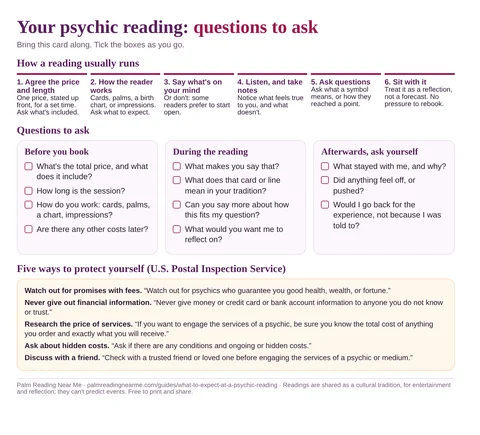
Questions to ask at a psychic reading: before you book, during, and afterwards, plus five protection tips. Free to print and bring along.
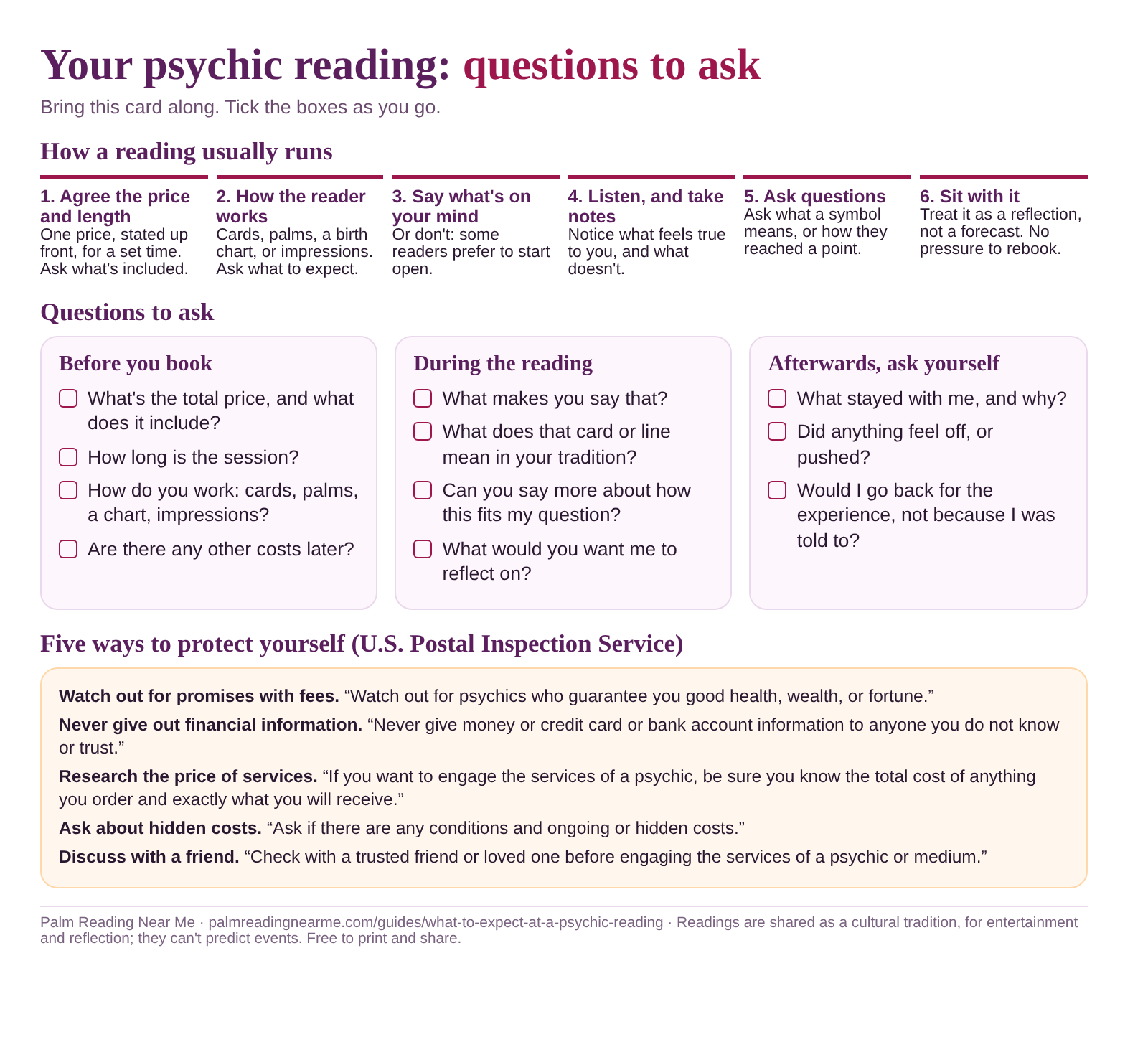
Free to share with a link back to this page.
How we checked this
Survey figures are from Pew Research Center's report of May 21, 2025, read on pewresearch.org on November 25, 2026. Protection tips are quoted from the U.S. Postal Inspection Service's "Psychic Scam" page, read the same day. The session outline describes how readings are usually run; readers differ, so ask yours. We don't list prices, because they vary widely by reader and city.
Where to go next
- Find a reader: our directory of palm readers and psychics near you.
- Compare the traditions: palm reading vs tarot vs astrology.
- Stay safe: psychic scam warning signs.
- The big question: is palm reading real?
Looking for a reader near you? Compare prices and ask the right questions first.
Find palm readers near meFrequently asked questions
›What happens at a psychic reading?
You agree a price and length, the reader explains how they work, you share a question or keep it open, they give their reading, and you ask questions. Most readings follow that shape, whether they use cards, palms, a birth chart or impressions.
›What should I ask a psychic?
Before booking, ask the total price, the length, and how they work. During the reading, ask what makes them say something or what a symbol means. Afterwards, ask yourself what stayed with you and whether anything felt pushed.
›How do I prepare for my first psychic reading?
Decide what you want from it, write down one or two questions, agree the price up front, and bring a notebook. Go in curious, and take what resonates.
›Do I need to tell the psychic anything?
No. Some readers ask for your name or birth date, and some prefer to know nothing. You can share a question or let them start open; it's your choice.
›How many people see psychics?
Pew Research Center found that 6% of U.S. adults consult a fortune teller at least once or twice a year, rising to 14% of adults under 30. Including astrology and tarot, 30% consult at least one practice a year.
›Can a psychic predict my future?
No one can promise that. Most people who visit psychics go mostly for fun or for insight, and Pew found just 1% rely on these practices a lot for major decisions. A good reading is a chance to reflect, not a forecast.
›How do I know if a psychic is legitimate?
A fair reader tells you one price up front, doesn't add fees, doesn't talk about curses or ask to cleanse your money, and doesn't pressure you to come back. The U.S. Postal Inspection Service advises checking the total cost and talking to a trusted friend first.
Sources
- 30% of Americans Consult Astrology, Tarot Cards or Fortune Tellers (May 21, 2025) (Pew Research Center)
- Psychic Scam (U.S. Postal Inspection Service)
Psychic readings are presented here as a cultural tradition and for entertainment and reflection. They can't predict events, and shouldn't replace advice from a doctor, lawyer, financial adviser or counselor.
More guides
Palmistry
Simian Line (Single Palmar Crease): What Palmists and Doctors Say
Guides
Palm Reading vs Tarot vs Astrology: Which Reading Is for You?
Palmistry
Can Science Prove Palmistry? What Science Still Can't Explain
Palmistry
Is Palm Reading Real? What a Reading Can Offer You
Palmistry
Palmistry and Astrology: The Seven Planets in Your Hand
Palmistry
Sun Line (Apollo Line) Meaning: Where It Starts, and What the Old Books Said
Palmistry
Marriage Line Meaning in Palm Reading: Every Shape, and What the Old Books Said
Palmistry
Palm Lines Meaning: A Chart of All 11 Lines
Palmistry
How to Read Palms: A Beginner's Guide, Step by Step
Palmistry
Heart Line Meaning in Palm Reading: What Palmists Say
Guides
How to Spot a Psychic Scam: Warning Signs and What to Do
Guides
Is Fortune Telling Legal? Palm Reading Laws by State and City